Thursday, April 25, 2013

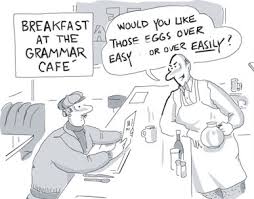
Ça marche? Oui, ça marche! Oh là là! C'est ne marche pas... maintenant.


www.illustrations-bd.com
(Revised 4/18/2016)
I first noticed the expression "Ça march?" in French class at L'Alliance Française de Paris  three years ago.

My French has advanced greatly since then as I continue to keep up my almost daily study of French and live my other side life as well. It's one of those expressions, that once you are aware of it, you wonder why no one made a point of teaching it to you.

My teacher, Lucie, would use a word that sounded like "maa-ch" to me and I would become totally confused. Being a word-for-word "literalist" (a disease that seems to be incurable), I got hung up on the tiniest things people say in French. (Still do.) I was a real "newbie" having only begun to learn French just 6 months before I was in that class and it was overwhelming as to what I didn't know... yet.

For instance, there was a vending machine outside our A.F. classroom door that didn't work. A sign had been hung on it with the words "en panne". Since the machine didn't work, I deduced that "en panne" meant the machine was out of order. Later on, I realized I’d been introduced to that expression before in an earlier class. From early on in my French studies French cars seemed always to be "en panne" in every lesson!

During classes, "C'est ne marche pas!" was said when something didn’t go well. One time, the Smartboard kept losing connection with the Internet and our teacher had to call in the mec who provided computer support. Thank goodness for computer systems support! Or, sometimes the door or furniture would be arranged in an undesirable configuration. “C’est ne marche pas!


cheezburger.com

Marcher doesn’t always just mean to walk or step. Marcher in this context is the word we’d use for “work”. As in, “That doesn’t work!” Why couldn’t I guess that on my own?  I am too literal.


Notez, s'il vous plait: Un mec qui est un type qui est un homme.

Wednesday, February 6, 2013

Learning and Remembering the Gender of French Words


Is this why ships are "shes"?

Since I began studying French seriously, I worried about ever memorizing the gender of French nouns. For anyone whose first language is English, this is quite a task. In general, we don’t have to remember what seems like an arbitrary assignment of gender to gender-free items such as telephones and barbeques. (Ships and boats were considered feminine, it's thought to be a left-over in English from borrowed language; most of us ignore this distinction and call a ship, “it”.) I mean, “Who cares?”

Unfortunately for us, lots of languages throw this stumbling block into their grammar. My personal experience with this includes Latin, Spanish, German and now French. And of course, these languages independently label the same words different genders than the other languages.

In French and Spanish, everything is masculine or feminine while in English, Latin and German there are 3 genders including “neuter”. Off the top of my head I remember that the Latin word for river is masculine and the word for island is feminine. The word for maiden, girl or maid in German is mädchen and is neuter! Pour quoi? (I’m half-German ancestrally, so I will not comment on why that might be.)

Now, I have recently found that there is a method to this madness in French. Although there are always the maddening exceptions which one just does have to memorize, consider the following very useful "rules of thumb" or guidelines:
How does a language have no gender at all?**

List of masculine endings on French words:
-age
-eau
-isme
-ment
-phone
-scope

List of feminine endings on French words:
-ance
-ence
-ette
-ode/-ade/ude
-sion
-té
-tion
-ure

My very first French teacher offered that a lot of feminine words end in –e, but you can see from the lists above that that advice really wasn’t all that useful. This list, which I discovered in the workbook, Grammaire Progressive du Française, Nouvelle Édition*, has really made determining the genders of unknown words so much easier for me. Once you can recall the differences between the lists, you will be very much better at reading, writing, and speaking a more-accurately complete French

*The workbook goes on to a very brief list of some common exceptions, but it’s not that valuable because there are many more exceptions than the 12 they list.
 ** Map from  languagesoftheworld.info


Tuesday, December 11, 2012

Multi-tasking: It Improves French Grammar and Christmas Planning


Chocolate Martini from americancocktails.com
December is not a crazy month for me anymore. While kids have grown up and move away, while I don’t have a job that offers a Christmas party, and while I no longer consider month-long Christmas activities at church relevant (no kids again)… well, it really has opened up the calendar to other things for me. I still adore Christmas, but studying French has given me something new with which to flavor our holiday activities.

Last night, I attended the last of 3 classes on the Fêtes de la France or the Holidays of France at my local Alliance Française. We learned about the weird origins of Père Noël in northeastern France (oddly, St. Nicolas was a bishop in Turkey and for some reason Greeks promoted the idea of this saint and his good works to other parts of the continent). We learned about the big, annual Christmas market in Strasbourg (they really love decorating Christmas trees there). And, last night, we learned about the 13 desserts of Provence (surely there is some weight gain during the holidays in Provence). The 10 inches of snow that fell over our week end really put me in a holiday mood looking out windows with snow collected on the sills.

This is the third December in which I find myself heavily invested in the improvement of my French grammar. For the first couple of years, I spent my December working on pesky irregular verbs and multitudinous verb tenses. December is the best month here for this, for it’s too cold or too rainy to spend a lot of time outdoors.

It’s so predictable in Minnesota to be confined more than desired. While I was in college, there were always mid-terms and finals on which to focus. Sure, we had the occasional snowball fight out in the dormitory courtyard, but that was just to blow off tensions built up by spending so much time focused on scholarly achievements.

So now I have been “hitting the books”, studying French, in my own unique style. I work grammar exercises in a work book for at least and hour a day. I’m not really good at long periods of sitting so I use multitasking to plan our upcoming Christmas in my "wiggle" time. I’ve been reading up on non-dairy chocolate martinis. French Christmas carols play in the background. I have a hula-hoop to exhaust my core muscles so I don’t feel like popping away from my desk every 5 minutes. I frequently read an article in French from Le Monde downloaded on my Kindle or translate something from France-Amérique magazine.

Multitasking is not a strategy I recommend normally. But in December, in comes in really handy. Strangely, it helps me to focus on having a good time for the season. Even better, December has become my traditional time to make great progress on improving my French. Now it's something to look forward to every year.

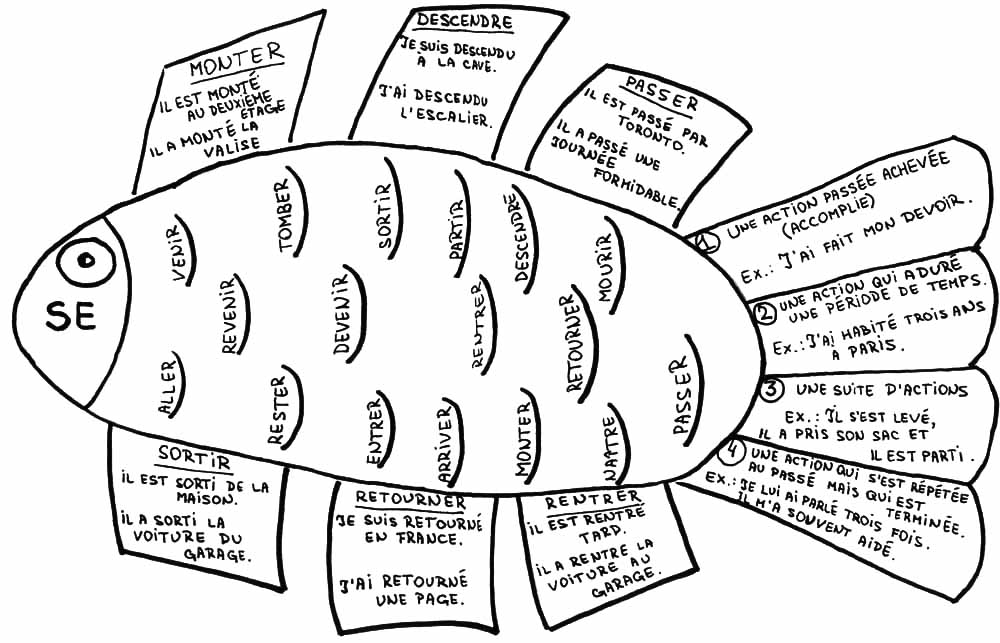
 Le passé composé     I love this. from fr.tsedryk.ca

Tuesday, November 20, 2012

When to use "à" and when to use "de"... a French Grammar Hell


from alienteachers.com

I've been struggling with correctly using French prepositions since the beginning... that is the beginning of my study of French. Prepositional use in English can be totally arbitrary and it seems it’s the same in French. 

For instance, in the northern U.S. we “wait for the bus” while further south in the States “we wait on the bus”. As Southern expressions press into traditionally northern sounds, language swirls around us in the Midwest like storm front patterns: Northern and Southern regions collide instead of hot and cold weather fronts. From my example, the second prepositional use, "on", is becoming more common every day. (So far as I know, nobody stands on top of a bus to wait for it, but that is the image using the word "on" in place of "for" conjures up in my mind.)

Another example of what seems to be arbitrary prepositional use: When my toddling daughter was learning to speak, she would say “You’re not the boss of me!”  I found this statement awkward and kept trying to correct her to say something like, “You’re not my boss!” 
 
Well, the problem with that statement (besides the discipline issues involved) was that the language around me had changed as fast as a storm blowing through and her sentence is now the more current version. I still don’t like the additional preposition in the sentence when none is needed. Shrugging it off, I lost that language battle.
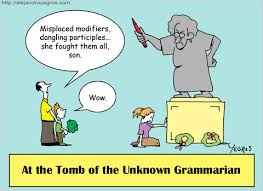
I’ve been working on correct usage of the French articles with prepostions in “Grammaire progressive du Français”, a C.L.E. publication. CLE International

Making French prepositional issues even more complicated, there is the matter of contracting male, female, and plural forms of articles with the prepositions à and de. The choices of these contractions are du, des, au, aux, à la, à l’, de la, and de l’.

This work book states that when the idea is
  • appartenance (affiliation) -- de is applied,
  • lieu (place) -- either de or à is used in different situations, and
  • avec (with) -- à is used in a flagrantly arbitrary style.
I have done all right with affiliation which seems to mean mostly possession of something (Henry’s dog or the color of the bicycle).

I’m OK with place for the most part but both de and à can designate place and I am trying to sort that one out. (We are going au restaurant but près du bureau.)

Language isn't science. (carbonfixated.com)
The idea of à as meaning avec, though, really forces an English speaker into new corners of grammatical hell. " pops up all over in places that an English speaker just wouldn’t conceive of… so this is the arbitrariness of prepositions. 

“It’s just usage, Suzan, get over it!”

As a practical matter, I am working through grammar workbook problems and trying to remember specific situations like pastry shop signs that read, “tartes aux pommes” not “tartes avec pommes” or “tartes de pommes”. Like gender, this is one of those grammar issues that has to be learned by developing a “feeling” for the use of these preposition through experience with the language, not by reasoning it out. 

Grammar is the point where science and language go their separate ways.
If you want to order pastries, you must know your prepositions! Photo from paloma81.blogspot.com


Friday, November 16, 2012

Text to Speech Tool: Improve French Pronunciation with "French Spanish Online" Site


Recently, while doing some grammar workbook problems, I stumbled across a very useful service, French Spanish Online. It consistently helps me to improve my French pronunciation. Go to this Adobe Flash application: “Text-to-Speech” Site Pal
French Spanish Online/Voice
and you will be able to follow my instructions below.

This tool is very simple to use in many languages. 
Follow these steps for hearing a word pronounced in French:
  • Choose French on the top drop down box
  • Type in the word or words with correct orthography (for instance, the accent marks are important)
  • Select a face (it is amazing how strange it is to hear a male voice while seeing a female image) on the second drop down box. Choices include males, females, a skeleton, a dog, and a guy that looks a lot like President Obama. When you click the 'say it' button, the lips move as though speaking! This is the first cartoon I've ever been able to lipread a bit.
  • Select the name of the speaker of which there are many. For instance, there are speakers with Canadian, Euro, and standard French pronunciations.
  • There are also drop down choices for effects and levels which I haven't figured out how to use yet.

I have been using this application for a couple of weeks. When there is a word to pronounce of which I am uncertain, this can be used for a really excellent “repeat after me” practice. The program also does very well at “speaking” whole phrases or sentences.  There are people's names with which I have great difficulty guessing at how they might be pronounced. I can finally now remember how to pronounce the name 'Leroy' with French flair.

Try a couple of different speakers, sometimes for the same word. For some reason the male pronunciation may be clearer to me than the female or vice versa. Pour quoi? J'en sais pas. 

For example, I just typed in 'semblable' because I couldn't get my lips to work to pronounce it. After listening to it, I was able to pronounce the word properly when before it was coming out of my lips as gibberish.

In the past, I have been able to use Google Translate intermittently much the same way. But for some reason lately, G.T. speech just hasn’t functioned. The Text-to-Speech works for me all of the time, every time.